

Introduction
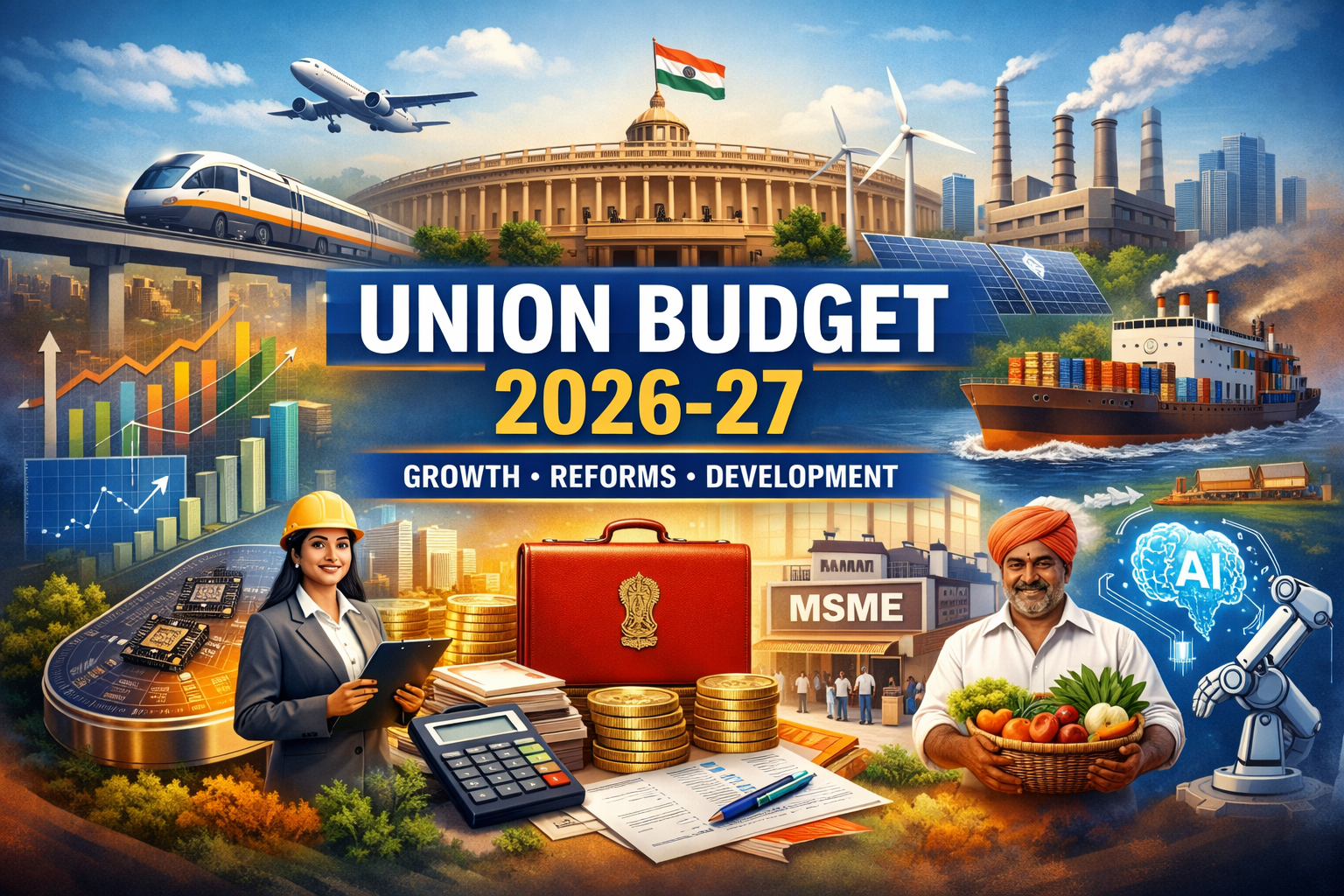
The Union Budget 2026–27 sets the tone for India’s next phase of economic growth with a strong focus on fiscal discipline, tax reforms, MSME support, and infrastructure expansion. The Union Budget 2026–27 highlights a forward-looking roadmap aimed at strengthening domestic manufacturing, boosting employment, and accelerating India’s journey toward becoming a developed economy while ensuring inclusive development.
Vision and Economic Strategy
The 2026–27 Budget is driven by a clear mission:
- Sustain high economic growth of around 7%
- Maintain moderate inflation and monetary stability
- Promote fiscal prudence
- Strengthen domestic manufacturing and energy security
- Enhance public investment and employment generation
The government continues structural reforms and deregulation initiatives to improve productivity, boost competitiveness, and create opportunities across sectors.
Major Pillars of the Budget
The budget is built around the following core pillars:
- People-centric development
- Trust-based governance
- Ease of doing business and ease of living
- Strengthening financial systems
- Sustaining long-term economic growth
Boost to Manufacturing Sector
A major focus has been placed on strengthening India’s manufacturing ecosystem, especially high-value and technology-driven sectors.
Key Initiatives:
- Revival scheme for 200 legacy industrial clusters
- India Semiconductor Mission 2.0
- Electronics components manufacturing support
- Three dedicated chemical parks
- Scheme for container manufacturing
- Hi-tech tool rooms in CPSEs
- Rare earth permanent magnets development initiative
- Affordable sports goods manufacturing push
Tax & Policy Support:
- 5-year tax exemption for non-residents supplying capital goods to toll manufacturers in bonded zones
- Duty-free imports for key manufacturing inputs and aircraft components
- Deferred duty payment window for trusted manufacturers
- Extended export timelines for textile and leather exporters
These measures aim to make India a global manufacturing hub and reduce import dependency.
Strong Push for MSMEs
MSMEs receive major financial and structural support under the 2026–27 Budget.
Key Announcements:
- ₹10,000 crore SME Growth Fund
- ₹2,000 crore top-up to Self-Reliant India Fund
- TReDS platform to be mandatory for CPSE purchases from MSMEs
- Credit guarantee for invoice discounting
- GeM linked with TReDS for faster financing
- “Corporate Mitras” to assist MSMEs in compliance
Additionally, the removal of the ₹10 lakh cap per consignment on courier exports will boost small exporters.
Services Sector Expansion
The services sector is positioned as a major growth engine.
Key Initiatives:
- Five hubs for Medical Value Tourism
- Education-to-Employment standing committee
- Training for 1.5 lakh multiskilled caregivers
- Expansion of AYUSH institutions and infrastructure
- AVGC content creator labs in 15,000 schools and 500 colleges
- National Institute of Design expansion
Tax Incentives:
- Tax holiday until 2047 for foreign companies offering cloud services from India-based data centers
- Safe harbour threshold for IT services increased to ₹2,000 crore
- Automated approval processes for tax certainty
Agriculture & Rural Development
To boost farmers’ income and productivity:
- Development of 500 reservoirs and Amrit Sarovars
- Strengthening fisheries value chain and exports
- Coconut promotion scheme
- Support for cashew, cocoa, and horticulture
- Expansion of high-density cultivation
- AI integration with AgriStack and ICAR systems
Massive Infrastructure Push
Infrastructure remains a central growth driver.
Major Projects:
- New freight corridors from Dankuni to Surat
- 20 new national waterways
- Coastal cargo promotion scheme
- Seaplane manufacturing initiative
- ₹2 lakh crore support to states under SASCI
- Integrated East Coast Industrial Corridor development
Urban Development:
- 7 high-speed rail corridors between major cities
- Focus on Tier-II & Tier-III city infrastructure
Energy Security & Sustainability
The budget emphasizes long-term energy stability through:
- Carbon capture projects with ₹20,000 crore outlay
- Duty exemptions for lithium-ion battery manufacturing inputs
- Support for solar glass and nuclear energy infrastructure
- Promotion of biogas-blended CNG
Financial Sector Reforms
Key financial system changes include:
- Incentives for municipal bond issuances
- Review of FEMA regulations
- Market-making framework for corporate bonds
- High-level committee for banking sector reforms
Tax Changes:
- STT on futures increased to 0.05%
- STT on options raised to 0.15%
Personal Tax & Compliance Relief Measures
Several measures aim to improve taxpayer convenience:
- Reduced TCS on foreign tours from 5–20% to 2%
- Reduced TCS for education and medical remittances to 2%
- Extended return revision deadline till 31 March
- Automated lower/nil TDS certificate for small taxpayers
- Decriminalisation of certain compliance defaults
- Foreign asset disclosure window for small taxpayers
Fiscal Outlook & Discipline
The government remains committed to fiscal consolidation:
- Fiscal deficit target: 4.3% of GDP (FY 2026–27)
- Debt-to-GDP ratio target: ~50% by 2030
- Continued 41% tax devolution to states
- ₹1.4 lakh crore allocated as Finance Commission grants
People-Centric Welfare Initiatives
The budget places strong emphasis on inclusive development:
- Training of 1.5 lakh caregivers
- Assistive device support for Divyangjan
- Emergency trauma care centres in district hospitals
- Self-Help Entrepreneur (SHE) Marts
- NIMHANS-2 mental health expansion
Conclusion
The Union Budget 2026–27 represents a balanced and reform-driven approach focused on growth, inclusion, and stability. With major investments in manufacturing, MSMEs, infrastructure, agriculture, and services, the budget lays a strong foundation for sustained economic expansion.
Tax simplification, compliance relief, and digital governance initiatives further strengthen ease of doing business and living. If effectively implemented, these measures can accelerate India’s progress toward becoming a global economic powerhouse.