

Introduction
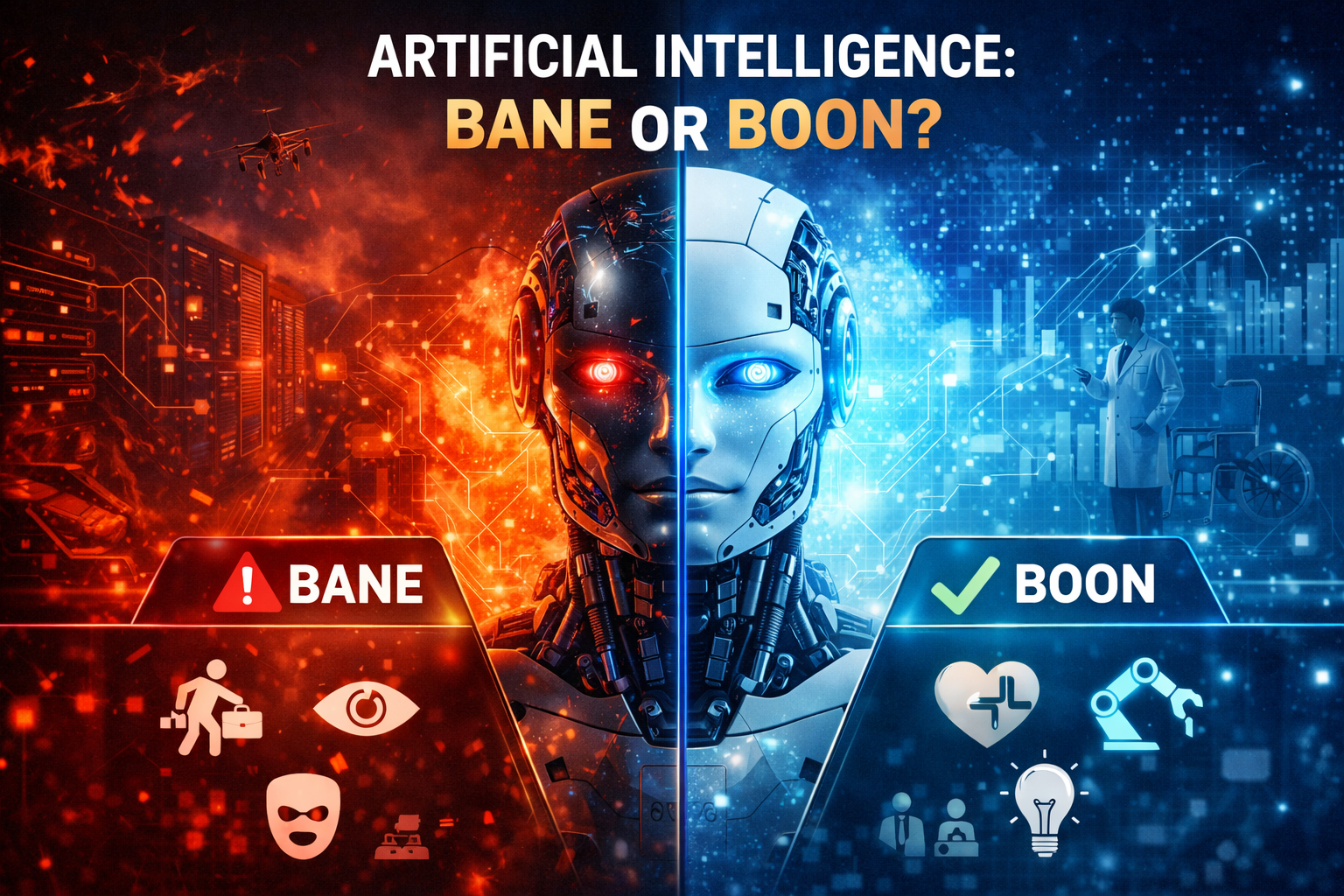
Artificial Intelligence (AI) has become one of the most debated technologies of the modern era. While it promises efficiency, innovation, and economic growth, it also raises concerns about job losses, privacy, and ethical risks.
Technology giants such as OpenAI, Google, and Microsoft are accelerating AI development, making the question increasingly relevant — Is Artificial Intelligence a boon or a bane?
The answer lies somewhere in between.
Understanding Artificial Intelligence
Artificial Intelligence refers to machines performing tasks that normally require human intelligence, such as learning, reasoning, decision-making, and communication.
AI technologies include:
- Machine learning
- Natural language processing
- Computer vision
- Generative AI
- Robotics
These systems are now embedded in everyday life — from smartphones to healthcare.
Artificial Intelligence as a Boon
✔ Increased Productivity
AI automates repetitive tasks, allowing humans to focus on strategic and creative work. Businesses can operate faster and more efficiently.
✔ Healthcare Revolution
AI helps in early disease detection, medical imaging, drug discovery, and personalized treatment.
✔ Better Decision-Making
Data-driven insights enable companies and governments to make smarter decisions.
✔ Economic Growth
AI is creating new industries, startups, and job roles such as AI engineers, data scientists, and prompt specialists.
✔ Improved Customer Experience
Chatbots, recommendation engines, and automation enhance user satisfaction and reduce response time.
Artificial Intelligence as a Bane
⚠ Job Displacement
Automation can replace routine roles in customer service, manufacturing, accounting, and data entry.
⚠ Privacy Concerns
AI relies heavily on data, raising issues around surveillance, misuse, and data breaches.
⚠ Bias and Ethical Risks
Algorithms may inherit human bias, leading to unfair outcomes in hiring, lending, or law enforcement.
⚠ Over-Dependence on Technology
Excessive reliance on AI may reduce human critical thinking and decision-making skills.
⚠ Cybersecurity Threats
AI can also be used to create sophisticated scams, deepfakes, and cyber attacks.
Impact on Jobs: Replacement or Transformation?
AI is not simply eliminating jobs — it is transforming them.
- Routine tasks are automated
- Hybrid human-AI roles are emerging
- Demand for digital skills is rising
- Creativity and strategy are becoming more valuable
History shows that technological revolutions create more opportunities than they destroy, but reskilling is essential.
AI and Society
Artificial Intelligence affects society beyond business:
- Education becomes personalized
- Smart cities improve infrastructure
- Financial inclusion expands
- Accessibility improves for disabled individuals
Countries like India are integrating AI into governance through initiatives such as Digital India.
Ethical Questions Around AI
The biggest debate is not technological — it is ethical:
- Who is responsible for AI decisions?
- Should AI replace human judgment in critical areas?
- How do we regulate powerful AI systems?
- Can AI be transparent and explainable?
Global policymakers are working toward responsible AI frameworks.
The Future: Human + AI Collaboration
Experts believe the future is collaborative, not competitive.
- AI handles speed and data
- Humans provide creativity, empathy, and judgment
The most successful professionals will be those who know how to work with AI rather than compete against it.
Final Verdict: Bane or Boon?
Artificial Intelligence is neither purely a boon nor purely a bane.
It is a powerful tool — its impact depends on how humans design, regulate, and use it.
With responsible implementation, AI can:
- Boost productivity
- Improve quality of life
- Solve global challenges
- Create new opportunities
Without safeguards, it can deepen inequality and risk misuse.
The choice ultimately lies with society.
FAQs
Is Artificial Intelligence dangerous?
AI itself is not dangerous, but misuse and lack of regulation can create risks.
Will AI replace humans completely?
No. AI is more likely to augment human capabilities than fully replace them.
How can individuals stay relevant in the AI era?
By learning digital skills, critical thinking, creativity, and AI literacy.