
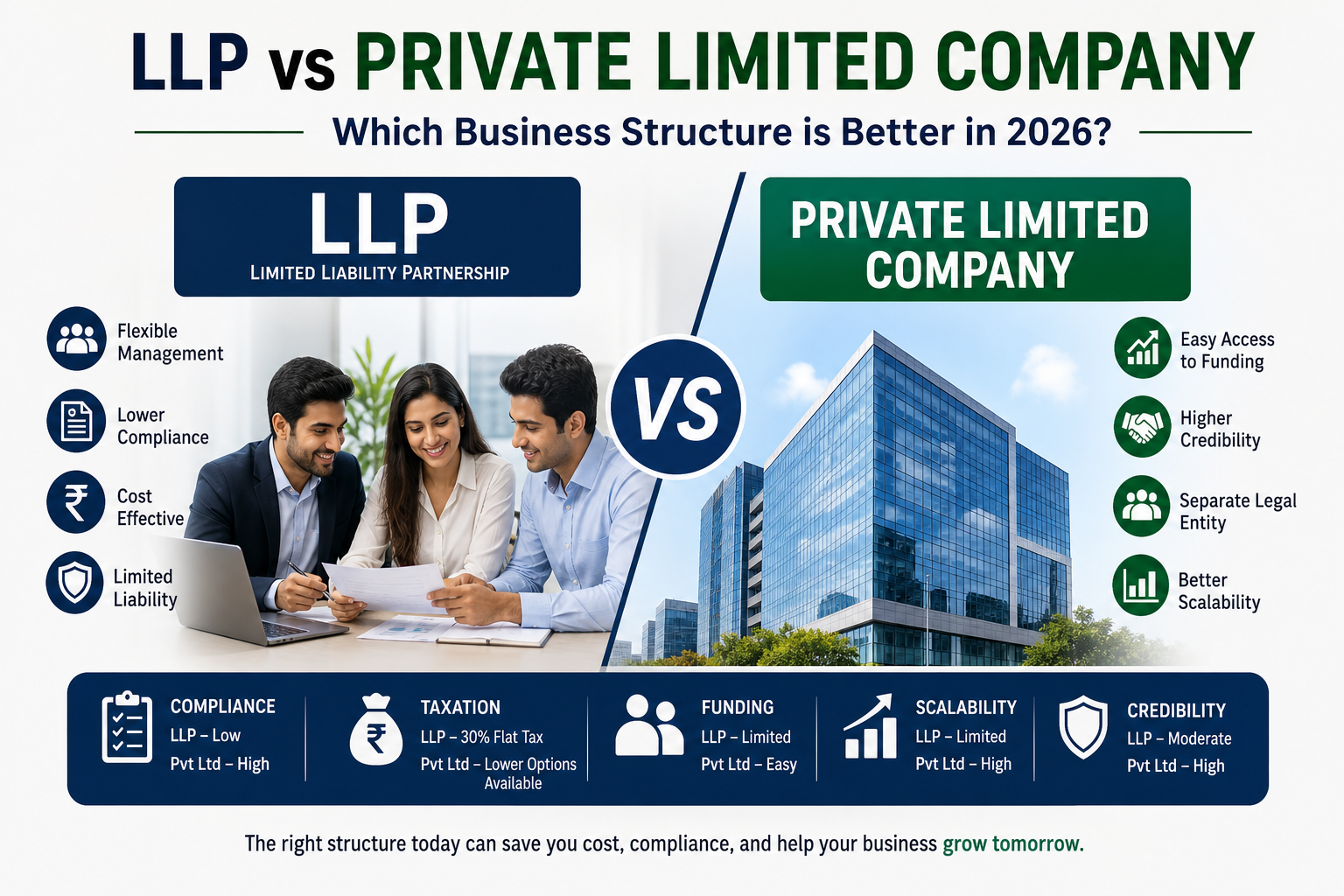

When deciding between an LLP vs Private Limited Company in 2026, business owners often struggle to identify which structure is better suited for their needs. This choice has a direct impact on your taxation, compliance burden, funding ability, and long-term scalability.
When setting up a business in India, one of the most common questions we get from clients is:
“Should I register as an LLP or a Private Limited Company?”
While both structures offer limited liability and separate legal status, the choice between the two should not be based on general perception—but on your business model, funding plans, and compliance capacity.
This article breaks down the difference in a practical, advisory-driven manner to help you make an informed decision in 2026.
Understanding the Basics
Limited Liability Partnership (LLP)
An LLP is best understood as a partnership with limited liability protection. It is governed by the LLP Act, 2008 and is ideal for businesses where operational flexibility is more important than scalability.
Best suited for:
- Professionals (CA, lawyers, consultants)
- Family-run businesses
- Small service providers
Private Limited Company
A Private Limited Company is governed by the Companies Act, 2013 and is a structured corporate entity with shareholders and directors.
Best suited for:
- Startups
- Businesses planning to raise funds
- Companies targeting long-term growth
LLP vs Pvt Ltd: Key Decision Factors
Instead of just listing differences, let’s look at this from a decision-making perspective.
1. Compliance Burden: Can You Handle It?
- LLP: Minimal compliance (no board meetings, fewer filings)
- Pvt Ltd: Regular ROC filings, board meetings, statutory audits
👉 Practical Insight:
If you are already struggling with GST, TDS, or income tax compliance, adding company law compliance may increase your burden.
2. Funding Requirement: Do You Need Investors?
- LLP: Limited options for external funding
- Pvt Ltd: Preferred by investors, VCs, and banks
👉 Practical Insight:
If you plan to raise funding—even after 2–3 years—start with a Pvt Ltd. Conversion later is possible but involves cost and compliance.
3. Taxation: What Works Better Financially?
- LLP: Flat 30% tax rate + surcharge
- Pvt Ltd: Lower tax options available under corporate tax regime
👉 Practical Insight:
For small profits, LLP works fine. But as profits increase, tax planning becomes more efficient in a company structure.
4. Ownership & Control
- LLP: Partners manage the business directly
- Pvt Ltd: Separation between ownership and management
👉 Practical Insight:
If you want tight control with fewer formalities, LLP is better.
If you want structured governance, go for Pvt Ltd.
5. Cost Consideration
- LLP: Lower registration and annual compliance cost
- Pvt Ltd: Higher due to audits, filings, and professional fees
👉 Practical Insight:
For early-stage businesses, saving compliance cost can be crucial.
6. Credibility in Market
- LLP: Acceptable, but limited perception
- Pvt Ltd: Higher trust among vendors, investors, and clients
👉 Practical Insight:
In sectors like tech, fintech, or e-commerce, Pvt Ltd is almost expected.
A Quick Comparison Table
| Criteria | LLP | Private Limited Company |
|---|---|---|
| Compliance | Low | High |
| Funding | Limited | Easy |
| Taxation | Flat 30% | Lower options available |
| Cost | Low | Higher |
| Scalability | Limited | High |
| Credibility | Moderate | High |
Which One Should You Choose?
Go for LLP if:
- You are starting small or solo
- You want ease of management
- You don’t need external funding
- You want to minimize compliance cost
Go for Private Limited Company if:
- You are building a scalable business
- You plan to raise investment
- You want brand credibility
- You are okay with structured compliance
Our Professional Recommendation
In today’s ecosystem (especially in 2026), we generally observe:
- LLP works best for stability
- Private Limited works best for growth
If your vision is limited to steady income, LLP is sufficient.
However, if you are thinking of expansion, funding, or valuation, starting as a Private Limited Company is a more strategic decision.
Final Word
Choosing the right structure at the beginning can save you significant tax, compliance, and restructuring costs later.
Before deciding, evaluate:
- Your projected turnover
- Funding plans
- Compliance handling capacity
- Long-term business vision
Need Help Choosing the Right Structure?
If you’re planning to start a business or restructure an existing one, a tailored evaluation based on your financials and goals is always better than a generic decision.
We assist with:
- Business structure advisory
- Company / LLP incorporation
- GST & tax setup
- Funding and compliance planning