

Introduction
Intellectual property plays a vital role in protecting the ideas, innovations, and brand identities that drive modern businesses. Whether you are an entrepreneur launching a startup, a creator producing original content, or a company developing innovative products, safeguarding your intellectual assets is essential.
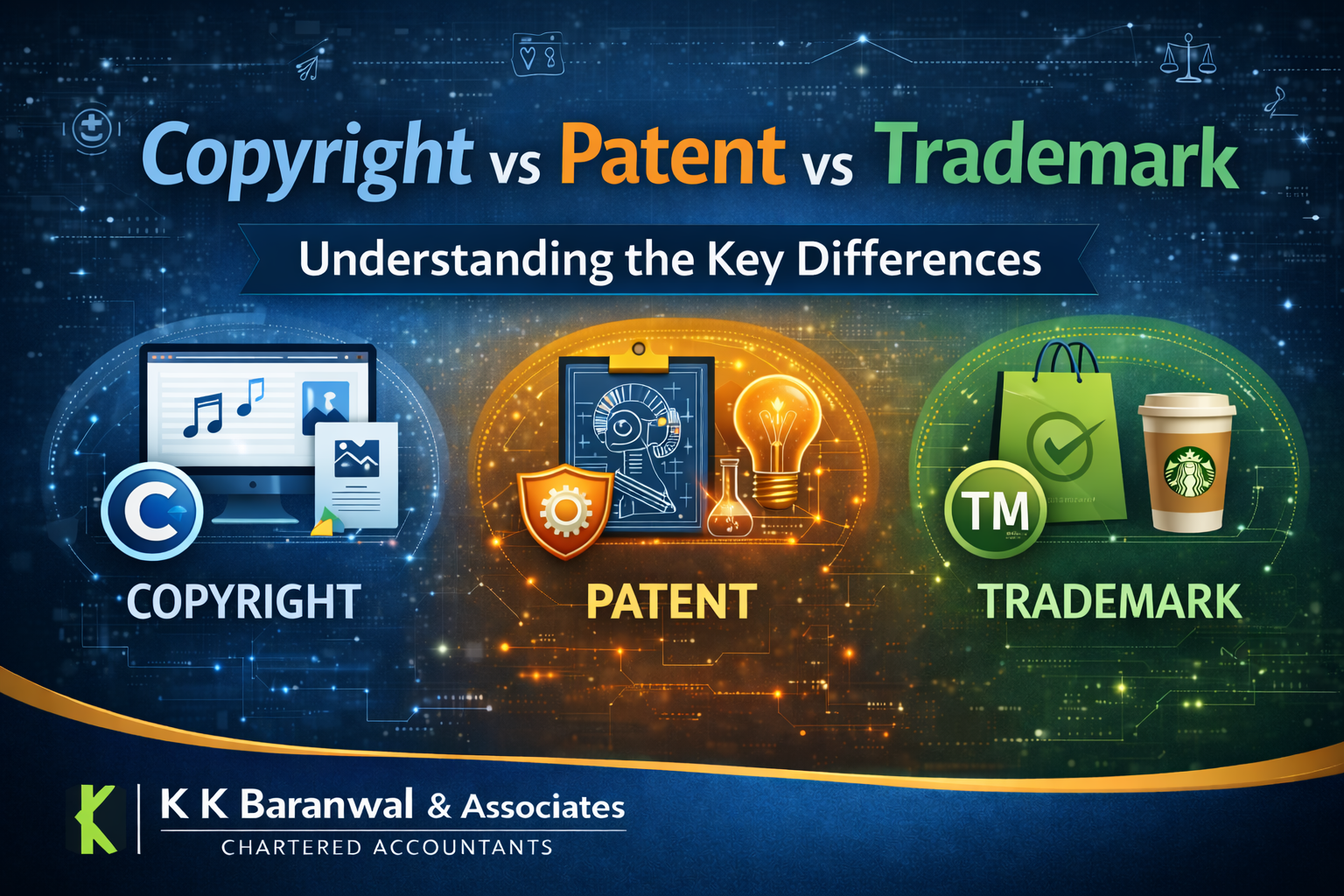
Three of the most commonly used forms of intellectual property protection are copyrights, patents, and trademarks. While these legal protections are often mentioned together, they serve very different purposes.
Understanding the difference between copyright, patent, and trademark helps individuals and businesses determine which type of protection is appropriate for their creations, inventions, and brand identity.
This guide explains each form of protection, how they work, and why they are important for businesses.
What is Copyright?
Copyright is a form of intellectual property protection that applies to original creative works that are expressed in a tangible form. This means the work must be recorded or written in a way that can be seen, heard, or reproduced.
Common examples of works protected by copyright include:
- Books and articles
- Music and songs
- Photographs and artwork
- Films and videos
- Software and computer programs
- Architectural designs
Copyright protection gives the creator exclusive rights to control how the work is used. These rights generally include the ability to:
- Reproduce the work
- Distribute copies
- Display or perform the work publicly
- Create derivative works based on the original
One of the key features of copyright protection is that it usually arises automatically when the work is created. The creator does not necessarily need to register the copyright to obtain protection, although registration may provide additional legal benefits.
In many jurisdictions, copyright protection lasts for the lifetime of the creator plus several decades after their death. This ensures that creators and their families can benefit from the work for a long period.
What is a Patent?
A patent protects new inventions and technological innovations. It grants the inventor exclusive rights to prevent others from making, using, selling, or importing the invention without permission.
Patents are typically granted for inventions that meet certain criteria, including:
- The invention must be new
- It must involve an inventive step
- It must be capable of industrial application
Patents can apply to a wide variety of innovations, including:
- Machines and devices
- Industrial processes
- Chemical compositions
- Pharmaceutical products
- Technological systems
Unlike copyright, patent protection does not arise automatically. The inventor must submit a formal application to the relevant patent authority, where the invention is examined before the patent is granted.
Once approved, patents usually provide protection for approximately 20 years from the filing date. During this period, the inventor has exclusive commercial rights to the invention.
However, patents require public disclosure of the invention. After the patent expires, the invention becomes part of the public domain and can be used by anyone.
What is a Trademark?
A trademark protects brand identifiers that distinguish the goods or services of one business from those of another.
Trademarks help consumers identify the source of products and prevent confusion in the marketplace.
Common examples of trademarks include:
- Brand names
- Logos
- Slogans
- Product packaging
- Symbols or designs associated with a brand
For example, a company name or logo used to identify products in the market can be registered as a trademark.
Trademark protection ensures that competitors cannot use identical or confusingly similar marks that might mislead consumers.
Unlike patents or copyrights, trademarks can potentially last indefinitely. As long as the trademark is actively used in commerce and properly renewed, the owner can continue to maintain the protection.
For businesses, trademarks are particularly valuable because they protect brand reputation and customer recognition.
Key Differences Between Copyright, Patent, and Trademark
Although these forms of intellectual property protection may appear similar, they protect very different things.
| Feature | Copyright | Patent | Trademark |
|---|---|---|---|
| What it protects | Creative works | Inventions and innovations | Brand identifiers |
| Examples | Books, music, art, software | Machines, chemical formulas, technology | Logos, brand names, slogans |
| How protection arises | Automatically upon creation | Requires formal application and examination | Usually requires registration |
| Duration | Life of author plus several decades | About 20 years | Potentially indefinite |
| Purpose | Protect creative expression | Encourage innovation | Protect brand identity |
Understanding these distinctions helps creators and businesses choose the appropriate legal protection for their work.
Can Different Types of Intellectual Property Overlap?
In many situations, a product or brand may benefit from multiple forms of intellectual property protection at the same time.
For example:
- A software application may have copyright protection for its code.
- The innovative technology behind the software may be protected by a patent.
- The software name and logo may be registered as trademarks.
Similarly, a company logo may be protected by copyright as a design and also registered as a trademark for brand protection.
This layered approach helps businesses secure different aspects of their intellectual assets.
Why Intellectual Property Protection is Important for Businesses
Protecting intellectual property is not only about legal rights; it is also a strategic business decision.
Businesses that protect their intellectual property can benefit in several ways.
1. Prevent Unauthorized Use
Legal protection prevents competitors from copying creative works, inventions, or brand elements.
2. Build Brand Identity
Trademarks help businesses establish a recognizable and trustworthy brand in the marketplace.
3. Encourage Innovation
Patents allow inventors to profit from their innovations, encouraging further technological advancement.
4. Increase Business Value
Intellectual property can become a valuable business asset, attracting investors and partnerships.
5. Strengthen Competitive Advantage
Companies with strong intellectual property protection can maintain a unique position in the market.
For startups and growing businesses, protecting intellectual property early can prevent costly legal disputes later.
When Should Businesses Consider Intellectual Property Protection?
Businesses should consider intellectual property protection in several situations, such as:
- Launching a new product or technology
- Developing original creative content
- Creating a new brand name or logo
- Building proprietary software or systems
- Introducing innovative industrial processes
Taking timely steps to protect these assets ensures that the business retains control over its innovations and brand identity.
Conclusion
Understanding the difference between copyright, patent, and trademark is essential for creators, entrepreneurs, and businesses.
Each form of intellectual property protection serves a distinct purpose:
- Copyright protects creative works such as books, music, art, and software.
- Patents protect inventions and technological innovations.
- Trademarks protect brand names, logos, and symbols that identify businesses.
By selecting the appropriate form of protection, individuals and businesses can safeguard their ideas, innovations, and brands while strengthening their long-term competitive position.
As intellectual property continues to play a central role in modern commerce, understanding these protections is an important step toward building a secure and sustainable business.
Frequently Asked Questions
What is the main difference between copyright, patent, and trademark?
Copyright protects creative works, patents protect inventions, and trademarks protect brand names, logos, and symbols used in commerce.
Do I need to register copyright to get protection?
In many countries, copyright protection arises automatically when a work is created. However, registration provides stronger legal evidence in case of disputes.
How long does patent protection last?
Patent protection typically lasts 20 years from the filing date, provided maintenance requirements are fulfilled.
Can a logo have both copyright and trademark protection?
Yes. A logo can be protected by copyright as an artistic design and also registered as a trademark to protect its use as a brand identifier.