
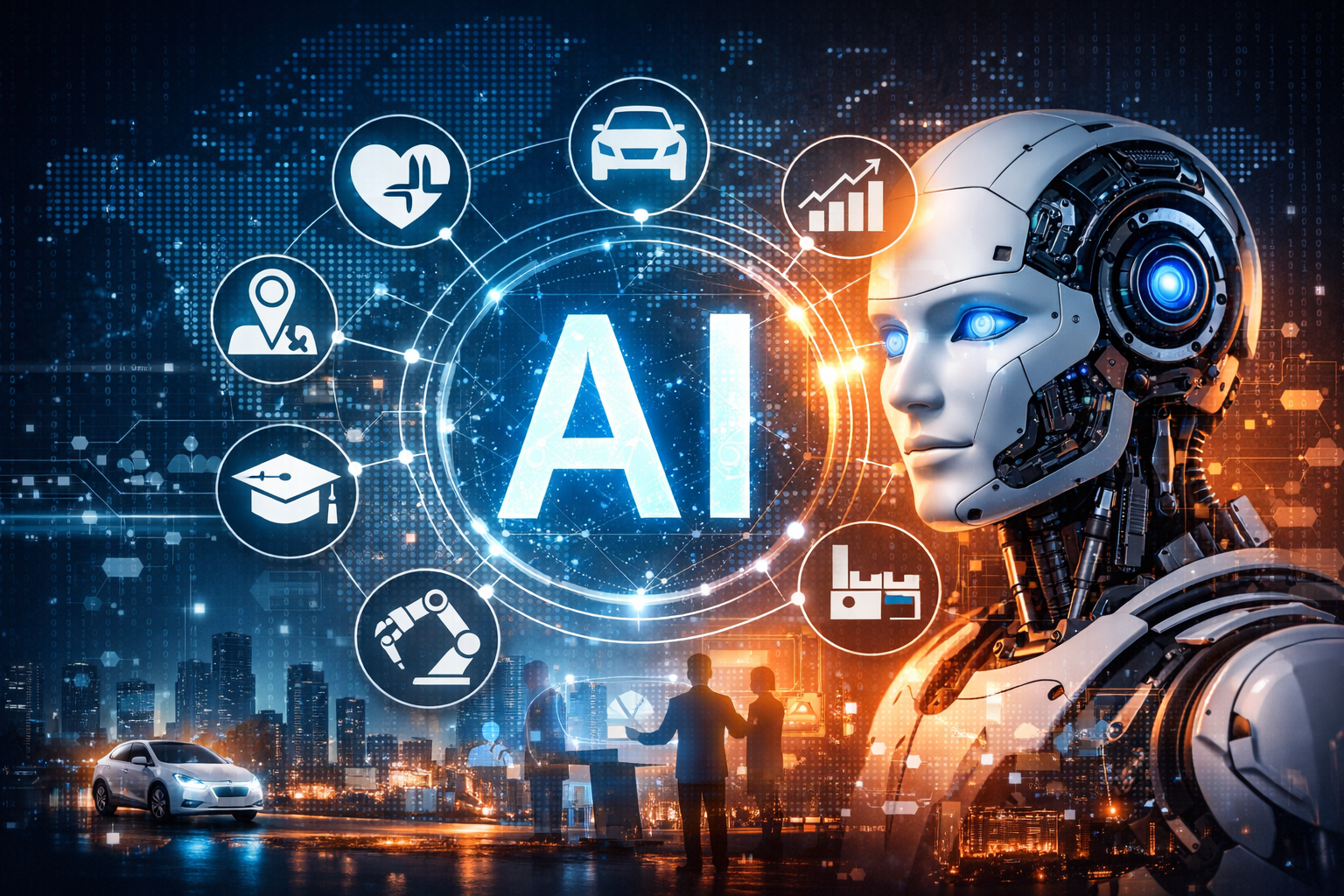

Focus Keyword: Artificial Intelligence
SEO Title: Artificial Intelligence in 2026 – Impact, Uses, Trends & Future
Meta Description: Explore how Artificial Intelligence is transforming industries, business, and daily life. Learn about AI uses, benefits, risks, and future trends in 2026.
Introduction
Artificial Intelligence (AI) is no longer a futuristic concept — it is part of our daily lives. From voice assistants and recommendation systems to automated customer service and medical diagnostics, AI is reshaping how individuals, businesses, and governments operate.
Companies across the world, including tech leaders like OpenAI, Google, and Microsoft, are investing heavily in AI innovation. As we move deeper into the digital era, understanding AI is essential for professionals, entrepreneurs, and students alike.
What is Artificial Intelligence?
Artificial Intelligence refers to the simulation of human intelligence in machines that can learn, reason, solve problems, and make decisions. AI systems use technologies such as:
- Machine Learning (ML)
- Natural Language Processing (NLP)
- Computer Vision
- Robotics
- Generative AI
These technologies allow software to perform tasks that previously required human intelligence.
Types of Artificial Intelligence
1. Narrow AI (Weak AI)
This is the most common type today. It performs specific tasks such as spam filtering, facial recognition, and chatbots.
2. General AI
A more advanced form where machines can perform any intellectual task like humans. This remains largely theoretical.
3. Super AI
A hypothetical future stage where AI surpasses human intelligence across all fields.
Real-World Applications of AI
Artificial Intelligence is impacting almost every sector:
✔ Healthcare
- Disease prediction
- Medical imaging
- Drug discovery
- Virtual health assistants
✔ Finance
- Fraud detection
- Algorithmic trading
- Credit scoring
- Robo-advisory
✔ Business & Marketing
- Customer analytics
- Chatbots
- Personalized advertising
- Automation
✔ Education
- Adaptive learning platforms
- Automated grading
- AI tutors
✔ Legal & Compliance
- Document review
- Contract analysis
- Tax automation
- Case prediction
Benefits of Artificial Intelligence
AI provides several advantages:
- Increased productivity
- Cost reduction
- Faster decision-making
- Improved accuracy
- 24/7 operations
- Enhanced customer experience
For startups and MSMEs, AI is becoming a major competitive advantage.
Risks and Challenges
Despite its benefits, AI presents certain risks:
- Job displacement
- Data privacy concerns
- Bias in algorithms
- Cybersecurity threats
- Over-reliance on automation
Governments worldwide are working on AI regulations to ensure ethical usage.
AI for Businesses and Professionals
Artificial Intelligence is transforming how professionals work:
- Chartered accountants use AI for tax automation
- Lawyers use AI for document analysis
- Marketers use AI for content generation
- Developers use AI for coding assistance
Entrepreneurs can leverage AI tools to scale faster with fewer resources.
Future Trends of Artificial Intelligence
The next decade will see rapid AI expansion. Key trends include:
- Generative AI dominating content creation
- AI agents performing complex tasks
- AI integration in smartphones and wearables
- Autonomous vehicles
- AI-powered governance
- Human-AI collaboration
Countries like India are investing heavily in AI infrastructure and startup ecosystems.
Opportunities in India
India offers massive opportunities in AI due to:
- Large digital population
- Growing startup ecosystem
- Government initiatives like Digital India
- Demand for automation in MSMEs
- Expansion of fintech and healthtech
AI is expected to contribute significantly to India’s GDP in the coming years.
How to Start Learning AI
Beginners can start with:
- Python programming
- Machine learning basics
- Online courses
- Open-source AI tools
- Practical projects
Consistency matters more than technical background.
Conclusion
Artificial Intelligence is one of the most powerful technological revolutions of our time. It is transforming industries, redefining jobs, and creating new opportunities.
Rather than replacing humans, AI will increasingly work alongside people. Businesses and professionals who adopt AI early will gain a strong competitive edge.
The future belongs to those who understand and leverage Artificial Intelligence.
FAQs
Is Artificial Intelligence difficult to learn?
No. With structured learning and practice, beginners can understand AI fundamentals.
Will AI replace jobs?
AI will replace some repetitive tasks but will also create new roles and opportunities.
Is AI useful for small businesses?
Yes. AI can reduce costs, improve efficiency, and enhance customer experience.